Yiwen Li made an oral presentation entitled Evaluation of WeCare 2.0: A Digital Health Intervention for Chinese American Dementia Caregivers. Sai made a poster presentation entitled Association of Neighborhood Socioeconomic Disadvantages and Nursing Home Quality: A Perspective of Social Determinants of Health. Both attended the conference the first time and made their first conference presentation, they also received student travel scholarships for their trips to Minneapolis. Congratulations to Yiwen and Sai!
Two Lab Members Presented at Academy Health Annual Research Meeting in Minneapolis
New publication from the team
Dr. Alicia Hong Receives Funding for ADRD Awareness Project
Dr. Alicia Hong received funding from Virginia Center for Aging Geriatric Training and Education (GTE) Initiative to support her innovative research. This one-year project, entitled ““Bridging the Gap: Enhancing ADRD Awareness Early Detection and Care through Community Health Worker Training in Underserved Minority Populations”, is an interdisciplinary collaboration with Dr. Janice Zhang of College of William and Mary and Dr. Daniel Bluestein of Virginia Commonwealth University.
Dr. Alicia Hong Joins NIH Panel on Lifestyle and Behavioral Health
Dr. Alicia Hong was invited to serve on the NIH Study Section of Lifestyle Change and Behavioral Health (LCBH), which reviews grant applications focusing on the adoption or uptake of health promoting behaviors or lifestyle changes to reduce health risks or to recover from diseases, conditions, or treatments at the individual or small group level. Applications typically use psychosocial and behavioral interventions to improve well-being.
Dr. Hong invited to serve on NIH Lifestyle Change and Behavioral Health (LCBH) Study Section
Dr. Hong was invited to serve on the NIH Study Section of Lifestyle Change and Behavioral Health (LCBH), which reviews grant applications focused on the adoption of health-promoting behaviors or lifestyle changes to reduce health risks or aid recovery from disease, at the individual or small-group level. Applications typically use psychosocial and behavioral interventions to improve well-being.
Dr. Alicia Hong Discusses Recruiting Dementia Caregivers at UCSF Brain Trust
Dr. Alicia Hong was invited to give a virtual presentation at the UCSF CARE Registry Brain Trust meeting. Her presentation, entitled “Recruiting Underserved Asian Americans Dementia Caregivers into Digital Interventions” is available here (30:50).
Dr. Hong presents at UCSF CARE Registry Brain Trust Meeting
Dr. Hong was invited to give a virtual presentation at the UCSF CARE Registry Brain Trust meeting. Her presentation, “Recruiting Underserved Asian Americans Dementia Caregivers into Digital Interventions,” is available online (30:50).
Lab members made multiple presentations at AcademyHealth Annual Research Meeting in Baltimore
Lab members Shema Salim, Kang Shen, Jo-Vivian Yu, Wish Chang, and Dr. Hong made multiple presentations at the AcademyHealth Annual Research Meeting, June 29–July 1, 2024, including: Salim S, Hong YA, “National Datasets with Social Determinants of Health Measures and Geocodes: Implications for Policy and Practice”; Salim S, Hong YA, “Neighborhood Socioeconomic Disadvantages and Nursing Home Quality: A Longitudinal Study”; Hong YA, Shen K, Chang WS, “Long-Term Effects of a WeChat-Based Intervention on Chinese American Dementia Caregivers: A Two-Year Follow-up Study”; Hong YA, Yu JV, Hong X, Gang Z, “Effect of Daily Dietary Tracking on Eating Behaviors Among College Students: Results from a Pilot Study”; Hong YA, Shen K, Chang WH, “Process Evaluation Via Weekly Assessment: Results from a WeChat-Based Intervention for Chinese American Dementia Caregivers.”
Dr. Hong receives a new R01 award from NIA
Dr. Hong has received a new R01 grant entitled “WECARE: A personalized intervention for underserved Chinese American dementia caregivers” from National Institute of Aging. This 5-year research project with funding of $3,088,427 includes Co-Is from Drs. Lily Wang and Jessica Lin from George Mason, Dr. Hae-Ra Han from Johns Hopkins and Dr. Ken Hepburn from Emory. The team will apply AI and digital tools to develop an interactive personalized program to enhance caregiving skills and quality of life for dementia caregivers, and conduct a RCT to evaluate it.
Dr. Hong receives a new NSF award
Dr. Hong has received a new NSF grant (2517316), as a Co-PI for a project entitled “Enhancing AI Literacy and Resilience through Intergenerational Digital Storytelling among Older Adults”. This 3-year research project with funding of $661,000 is a joint collaboration with Dr. Janice Zhang, Assistant Professor of Computer Science from College of William and Mary. Together they will develop and evaluate an interactive platform that allows older adults and youths to co-design a digital story-telling platform for inter-generational learning. The project seeks to strengthen AI literacy, social connectedness, and resilience among older adults while cultivating responsible AI awareness in youth.
Dr. Alicia Hong Receives Funding for ADRD Awareness Project
EMBRACE Project Funded to Build Resilience in Aging Communities
EMBRACE Project Funded! Dr. Alicia Hong led a team of interdisciplinary scientists (Dr. Amira Roess, Dr. Ali Weinstein, and Dr. Siddhartha Sikdar) and received the inaugural Network Catalyst Grant from the Mason Institute of Sustainable Earth. The funded project entitled Empowering and Building Resilience through Active Coalition and Aging (EMBRACE) will establish a community-academic partnership that involves George Mason University researchers and community-based organizations in the Greater Washington DC area.
EMBRACE Project Funded!
Dr. Hong led a team of interdisciplinary scientists (Dr. Amira Roess, Dr. Ali Weinstein, and Dr. Siddhartha Sikdar) and received the inaugural Network Catalyst Grant from the Mason Institute of Sustainable Earth. The funded project, Empowering and Building Resilience through Active Coalition and Aging (EMBRACE), will establish a community-academic partnership involving George Mason University researchers and community-based organizations in the Greater Washington DC area.
WECARE 2.0 Secures Funding to Support Chinese American Dementia Caregivers
WECARE 2.0 was funded by National Institute of Aging Roybal Caregiving Center! The project entitled “WECARE: A social media-based personalized intervention to enhance caregiving mastery among Chinese American dementia caregivers received $115,000 from Emory Royball Center for Dementia Caregiving Mastery. With the funding, the team will test the updated version of Wellness Enhancement for Caregivers, or WECARE 2.0, a WeChat-based intervention to improve caregiving mastery and reduce psychosocial distress among Chinese American dementia caregivers.
Stronger2 Project receives no-cost extension from Office of Minority Health
The Stronger Partnership Stronger Community: Using Health Literacy to Increase Resilience (Stronger2) project was funded by the HHS Office of Minority Health and led by Fairfax County Health Department for a total of $3,875,000 in 2021. Through partnership with community organizations, Stronger2 aims to improve health outcomes in communities of color by cultivating individuals’ ability to find, understand, and use health information and services in a culturally and linguistically appropriate manner. Dr. Hong leads program evaluation and technical support for the project; other GMU team members include Dr. Farrokh Alemi and multiple graduate students. The no-cost extension allows the team to explore new initiatives to serve the community.
Dr. Alicia Hong led an interdisciplinary team and received a seed grant of $50,000
Dr. Alicia Hong led an interdisciplinary team and received a seed grant of $50,000 from College of Health and Human Services for a research project entitled “Prototype development of EARBUD: A Wearable Sensor System for Dietary Monitoring and Personalized Intervention”. This study aims to develop a prototype of a wearable sensor system (earbuds) to track dietary intake for personalized nutrition intervention. Other key personnel includes Drs. Hong Xue and Larry Cheskin of CHHS and Dr. Gang Zhou from College of William and Mary.
KakaoTalk-based intervention promote HBV screening and liver cancer prevention
The results of a KakaoTalk-based intervention promote HBV screening and liver cancer prevention among Korean Americans were published on Digital Health. This study was funded by Potomac Health Foundation, PI was community partner Ms. Soo Yee, Founder and President of Korean American Outreach Group.
Virginia Center for Aging Alzheimer’s and Related Diseases Research Award Fund
Dr. Alicia Hong, along with Dr. Sojung Kim and Dr. Emily Ihara received a grant of $45,000 from Virginia Center for Aging Alzheimer’s and Related Diseases Research Award Fund for the project entitled “Alzheimer’s Research Inquiry and Care for Asian Americans (ARICAA): Protocol Development of a Culturally Tailored Social Media-Based Program”. This study aims to develop social media-based program to promote awareness of and of and participation in clinical research of Alzheimer’s disease among Asian Americans.
Dr. Hong invited to deliver Tay Gavin Erickson Lecture at UMass Amherst
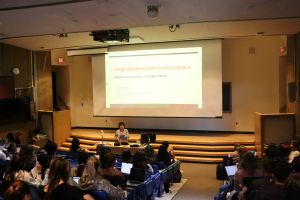
Dr. Hong has been invited to deliver the Tay Gavin Erickson Lecture at the UMass Amherst Center for Research on Families on April 28, 2026. Her talk, “From Information to Intelligence: Health Communication in a Digital World,” examines how digital and AI-enabled tools are transforming health communication, with implications for chronic care, family caregiving, and underserved communities. The visit will also include mentoring time with early-career faculty at the Center.
Dr. Alicia Hong Joins NIH Panel on Lifestyle and Behavioral Health
Dr. Hong presents at UCSF CARE Registry Brain Trust Meeting
Lab Members Present at Academy Health Annual Research Meeting
Lab members Shema Salim, Kang Shen, Jo-Vivian Yu, Wish Chang, and Dr. Alicia Hong made multiple presentations at Academy Health Annual Research Meeting in Baltimore, MD, June 29 to July 1, 2024:
- Salim S, Hong YA. National Datasets with Social Determinants of Health Measures and Geocodes: Implications for Policy and Practice.
- Salim S, Hong YA. Neighborhood Socioeconomic Disadvantages and Nursing Home Quality: A Longitudinal Study from a Perspective of Social Determinants of Health.
- Hong YA, Shen K, Chang WS. Long-Term Effects of a WeChat-Based Intervention on Chinese American Dementia Caregivers: A Two-Year Follow-up Study.
- Hong YA, Yu JV, Hong X, Gang Z. Effect of Daily Dietary Tracking on Eating Behaviors Among College Students: Results from a Pilot Study.
- Hong YA, Shen K, Chang WH. Process Evaluation Via Weekly Assessment: Results from a WeChat-Based Intervention for Chinese American Dementia Caregivers.
Society for Behavioral Medicine Annual Conference
Lab members made a poster presentation at the Society for Behavioral Medicine Annual Conference in Philadelphia, PA, March 13~16, 2024: Hong YA, Yu JV, Xue H, Zhou G. Eating behaviors and eating environment among college students: A longitudinal study using mobile tracking and surveys.
Lab members presented a poster at the Society for Behavioral Medicine Annual Conference
Hong YA, Yu JV, Xue H, Zhou G, “Eating behaviors and eating environment among college students: A longitudinal study using mobile tracking and surveys,” presented in Philadelphia, PA, March 13–16, 2024.
Dr. Hong invited to panel at UConn Center for mHealth and Social Media 7th Annual Conference
Dr. Hong was invited to the panel “How Can Public Health Better Utilize Social Media — Challenges and Opportunities.” She shared her experience using social media to reach underserved populations for health promotion and interventions.
Dr. Hong presents at UCSF PRISM Conference
Dr. Hong was invited to present at the UCSF Promoting Research in Social Media and Health Symposium (PRISM), on the panel “International Perspectives on Social Media and Global Health.” She shared her experience using WeChat to reduce stress, stigma, and depressive symptoms among people living with HIV in China.
Dr. Hong continues to serve on NIH study sections for Clinical Care and Health Informatics, and Lifestyle Change and Behavioral Health
Dr. Hong continues her NIH grant review service this year on two study sections at the Center for Scientific Review. In April 2026, she served on the Clinical Care and Health Informatics (CCHI) study section. In June 2026, she continued her ongoing service on the Lifestyle Change and Behavioral Health (LCBH) study section. Both panels review research grant applications across digital health, behavioral interventions, and health informatics.
Dr. Hong invited to review for European national science foundations
Dr. Hong has been invited to serve on grant review panels for two European national science foundations. In November to December 2025, she reviewed for the Swiss National Science Foundation (SNSF). In May 2026, she reviewed for the Netherlands Organisation for Scientific Research (NWO) Talent Programme Vidi SSH — a flagship program supporting mid-career researchers across the social sciences and humanities. These appointments add to her ongoing international grant review record, which also includes prior service for the Austrian Science Foundation.
Artificial Intelligence and Health Graduate Certificate available in Spring 2026, Dr. Hong designed the program
The new Graduate Certificate in Artificial Intelligence in Health is available from Spring 2026. AI is reshaping public health and healthcare in real-time; how can professionals and students in the AI era get ready for the changing work environment and career opportunities? This certificate is designed to help them get ready. The training will prepare leaders who can responsibly harness AI to improve health care quality, reduce inefficiencies, and enhance both patient and population health. Dr. Hong led Health Informatics faculty and designed this 15-credit program.
Dr. Hong invited to serve on NIH Lifestyle Change and Behavioral Health (LCBH) Study Section
Dr. Alicia Hong Discusses Recruiting Dementia Caregivers at UCSF Brain Trust
Dementia Care and Caregiving Support Intervention Research
Dr. Alicia Hong was invited to serve on NIA Special Emphasis Panel on Dementia Care and Caregiving Support Intervention Research. The panel reviews grant applications on support and services for people living with Alzheimer’s Disease and related dementias (ADRD) and their caregivers.
Dr. Hong invited to serve on NIA Special Emphasis Panel on Dementia Care and Caregiving Support Intervention Research
The panel reviews grant applications on support and services for people living with Alzheimer’s Disease and related dementias (ADRD) and their caregivers.
Dr. Alicia Hong Joins NIMHD Panel on Minority Health Technologies
Dr. Alicia Hong was invited to serve on National Institute of Minority Health and Health Disparities (NIMHD) Special Emphasis Panel of Technologies for Improving Minority Health Eliminating Health Disparities.
Jo-Vivian Yu graduates with honors and presents capstone project
Jo-Vivian Yu gave an impressive presentation of her capstone project, “Eating Environment and Eating Behaviors of College Students,” and graduated with a Master of Science in Health Informatics with honors. Congratulations, Jo-Vivian! She now works as a statistician/data analyst at the U.S. Census Bureau.
Dr. Lisa McKeown’s first manuscript from her thesis
Dr. Lisa McKeown’s first manuscript from her thesis was published! The article entitled Trends and Differences in Perceptions of Patient-Centered Communication Among Adults in the US” was published on Patient Education and Counseling. Lisa graduated in August 2023 and works as program manager at MITRE.
Dr. Lisa McKeown’s first manuscript published
“Trends and Differences in Perceptions of Patient-Centered Communication Among Adults in the US” was published in Patient Education and Counseling. Lisa graduated in August 2023 and works as a program manager at MITRE.
Kang (Kathy) Shen received the Research Honor Roll from College of Public Health Only one student from the college would receive this highest honor of research each year. Congrats Kang!
Kang (Kathy) Shen receives Research Honor Roll from College of Public Health
Only one student from the College receives this highest research honor each year. Congrats, Kang!